The best corporate event entertainment gives people something to do, not only something to watch. Match the format to your crowd, your room and your goal. Then check the practical details (power, load-in time, timing) before you book. Below you'll find the main options for Australian corporate parties, launches, conferences and gala dinners, plus a simple way to choose between them.
TL;DR
- Split your options into two groups: watching acts (bands, comedians, MCs) and joining-in activities (workshops, games, photo booths). Most good events use one of each.
- Pick by audience size, room layout and event goal, not by what sounded fun in someone else's wrap-up.
- Brand activations and product launches work best when guests leave with something physical that carries your branding.
- Settle guest numbers, venue, budget, load-in time, power and schedule buffers before you shortlist anything.
- Mix quiet and loud moments, and give shy guests a low-pressure way to take part.
Table of Contents
- What corporate event entertainment actually needs to do
- Watching formats: bands, comedians and hosts
- Interactive formats that get guests involved
- Ideas for brand activations and product launches
- Ideas by audience size and setting
- How to choose entertainment that fits
- The practical checklist before you book
- Why we think a photo booth belongs in the mix
- Hire a booth built around your event
- Putting a program together: two examples
- Common mistakes to avoid
- FAQ
- Sources
What corporate event entertainment actually needs to do
Entertainment at a work event has a harder job than at a private party. Guests may not know each other, some are there out of obligation, and the person who booked it is usually judged on how the night felt.
So before you think about acts, decide which of these jobs matters most:
- Break the ice at networking nights and team days.
- Lift the energy between speeches, courses or award categories.
- Carry the brand at a launch, in-store event or sponsored activation.
- Reward people at an end-of-year party, where the aim is simply a good night.
A single event can do two of these well. Trying to do all four with one act usually does none of them well.
Watching formats: bands, comedians and hosts
These are the traditional picks, and they still earn their place at gala dinners, awards nights and Christmas parties.
Live music. A cover band or DJ sets the pace after dinner and gives people a reason to stay. Quiet acoustic music works earlier in the evening, during arrivals or drinks, when guests still want to talk.
Comedians. A short stand-up set can reset a room between formal segments, especially when the material is tailored to your company or industry. It's a watching format, so place it where you want attention on the stage, not where you want people mingling.
MCs and hosts. A good host keeps an awards night moving and covers dead air. They suit any event with a run sheet, speeches or presentations.
Magicians and mentalists. Close-up performers who roam the room give small groups something to talk about. They suit cocktail functions where people stand and circulate.
The common limitation is that guests are an audience. That is fine when you want a shared moment. It's less useful when the goal is for people to meet each other or interact with your brand.

Interactive formats that get guests involved
If your brief says "engagement", look at activities where guests are participants. The Melbourne Convention Bureau's roundup of hotel-recommended team activities lists escape rooms, karaoke, cocktail-making workshops, mini golf and freehand spray-paint classes for conference and incentive programs. They share a trait: small groups work on something together, and the conversation comes from the activity rather than being forced.
Here is how the main interactive options compare.
| Format | Best for | Room needed | Pressure on guests |
|---|---|---|---|
| Cocktail or cooking class | Team days, incentive groups | Kitchen or bar-style space | Low to medium |
| Escape room | Teams of up to a dozen or so per room | Off-site venue | Medium |
| Karaoke | Christmas parties, after-dinner | Stage or corner, sound system | High for shy guests |
| Trivia or game show | Sales teams, competitive groups | Seated room with a host | Medium |
| Creative class (e.g. spray-can art) | Teams that want something to take home | Space for materials | Low |
| Photo booth | Any size, any setting | Compact footprint | Low |
The last column matters more than most planners expect. Karaoke or an on-stage game can be the highlight for extroverts and a source of dread for everyone else. Formats where people choose how much to take part, like a creative station or a photo booth, let the whole room join in at its own pace.
Ideas for brand activations and product launches
At a launch the entertainment is part of the message. Guests should leave remembering your product, not only the band.
A few ideas that fit:
- Branded photo experiences. A booth styled to your campaign puts your colours, logo or product visuals into every photo guests share. Prints they can hold become small pieces of brand collateral.
- Product-led activities. If you sell something tactile, build the activity around it: a styling session for a fashion retailer, a tasting for a beverage brand.
- Short live moments. A host, a performance or a reveal to mark the launch, then back to mingling.
- Shareable set pieces. Anything guests want to photograph does some of your promotion for you.
For in-store events, footprint and flow matter. You need something that draws people in without blocking the floor or the till.
Ideas by audience size and setting
Under 50 guests (team days, client dinners). Go small and hands-on: a workshop, a tasting, a host-led game, a booth in the corner. Big sound systems and stages are wasted here.
50 to 150 guests (end-of-year parties, launches). This is where a mix works well: a roaming or background act early, one feature moment, and an interactive attraction running all night so guests dip in and out.
150-plus guests (galas, conferences, festivals). Run entertainment in parallel so queues don't form. A stage act for the room, plus several stations spread around so people always have somewhere to go.
Seated dinners. Time is tight between courses. Short sets, a host and something that can run in the foyer during drinks keep things moving.
Cocktail-style events. Guests are on their feet. Roaming performers and self-serve attractions beat anything that needs everyone to sit and watch.
Outdoor or unusual venues. Check weather cover, power and access early. An enclosed booth or a covered station can be easier to place than a full stage setup.
How to choose entertainment that fits
Work through these in order and the shortlist writes itself.
- Name the goal. Ice-breaking, energy, brand exposure or reward.
- Know your audience. Age range, how well they know each other, how they feel about being put on the spot. Hosted game shows suit competitive or sales-minded groups, while quieter people prefer formats that don't single them out.
- Measure the room. Ceiling height, floor space, where guests will stand or sit.
- Set the budget before you collect quotes, so you compare like with like.
- Check brand fit. The tone of the entertainment should match the tone of the company. A formal awards night and a casual product party want different things.
- Pick one headline and one background option. Then stop. Overfilled programs feel rushed.
The practical checklist before you book
Most entertainment problems are logistics problems. Before you sign anything, confirm:
- Guest numbers and event type, so the supplier quotes for the right scale.
- Venue approval. Many venues need to approve suppliers, and some have rules on noise, power or access.
- Load-in and bump-in times. When can the supplier get in, and how long do they need?
- Power, sound and lighting. What is supplied, and what must they bring?
- Stage or floor space. Measured, not guessed.
- Schedule buffers. Speeches run over. Build gaps so entertainment can start late without the whole night slipping.
- Bump-out time. When must everything be cleared?
Send this list to every supplier you're considering. The ones who answer clearly and quickly are usually the ones who run smoothly on the night.
Why we think a photo booth belongs in the mix
We built Offcam around a simple idea: the best photos at an event are the ones nobody posed for.
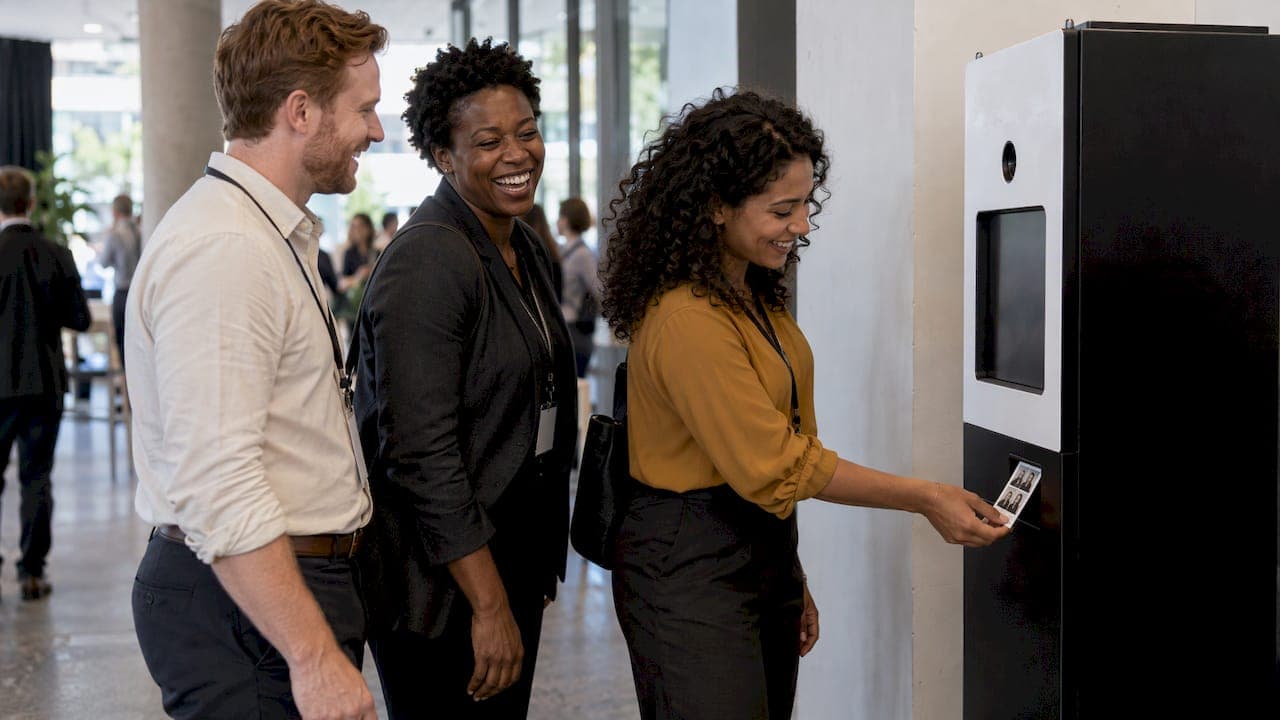
At a corporate event, guests are often a little guarded. An enclosed, vintage-style booth changes that. Guests duck behind the curtain, the room disappears, and for a minute they're just having fun with whoever they walked in with. That's a moment, not a station.
It also works hard for the brand. We design the booth and the print strip around your event, so your branding sits inside the experience rather than being stuck on the side of it. Guests leave with an instant physical print, and can share digitally too, so the memory travels beyond the night.
We think of it as the attraction that suits everyone in the room: the confident guest who wants to ham it up, and the quieter one who would never go near a stage.
the author
Hire a booth built around your event
If your event needs an interactive attraction that guests choose to join, our photobooth hire is made for it. Our booths are enclosed and vintage-style, with custom branding, instant physical prints, digital sharing and event-specific strip design. We tailor the set-up to your event space, whether that's a launch, a retail activation, a wedding or an end-of-year party.

See the customisable photo booth we offer, or enquire about your event with your date, venue and guest numbers and we'll take it from there. For more ideas on styles, browse our vintage photobooth articles and custom photobooth guides.
Putting a program together: two examples
Ideas are easier to use when you can see them in a run sheet. These are planning sketches, not case studies.
End-of-year party for 120 staff, evening venue.
- Arrivals: quiet background music and a photo booth open from the first guest through the door.
- Mid-evening: a host kicks off a short trivia round between courses, then awards.
- After dinner: a DJ or band takes over, and the booth stays open so people who don't dance still have something to do.
Fashion retailer in-store launch, two hours.
- A branded booth near the entrance, with strips designed around the new collection.
- A short host moment for the reveal.
- Guests leave with a printed strip, which doubles as a reminder of the brand and the occasion.
In both, one attraction runs all night and one or two feature moments punctuate it. That structure scales up or down.
Common mistakes to avoid
- Booking for the loudest person in the office. Karaoke sounds great in the planning meeting. Ask who will actually sing.
- Forgetting the quiet half. Include at least one option that needs no performance from guests.
- Cramming the schedule. Entertainment needs space. Leave time for conversation too.
- Leaving logistics to the last week. Power, access and venue approval take time to sort.
- Treating brand as an afterthought. If it's a launch or activation, ask how each option carries your identity.
FAQ
What is the best entertainment for a corporate event?
It depends on the goal. A live band or host suits gala dinners and awards nights, while workshops, games and photo booths suit events where you want people to mingle. Most successful events combine one headline act with one all-night interactive attraction.
What are good interactive corporate event ideas?
Cocktail-making, cooking classes, escape rooms, karaoke, mini golf and creative classes are all commonly recommended for conferences and team events. For larger groups, a photo booth or hosted trivia lets many people take part at once without long queues.
How far ahead should I book corporate entertainment?
As early as your date and venue are confirmed, especially for end-of-year season, when demand is highest. Booking early also leaves time for venue approval and for settling power, access and load-in details.
What should I look for when choosing entertainment for a corporate party?
Check that it suits your audience, your room size and your budget, and that it fits the tone of your company. Then confirm the practical items: load-in time, power, space and how it fits your run sheet.
How do I keep shy guests involved?
Offer options where people choose their level of participation. A photo booth, a creative station or a background activity lets quieter guests join in on their own terms, while a stage act or hosted game suits those who enjoy the spotlight.